
Music lesson cancellation policy template
A music lesson cancellation policy template should say how families cancel, which cancellations earn a makeup credit, and how that credit can be used. Give teacher cancellations their own rule, and state what happens to missed lessons. Copy the wording below, then replace the brackets and choose only deadlines and remedies you can deliver.
Copy this music lesson cancellation policy template
This version is for a teacher who offers makeup credits for eligible cancellations. It leaves tuition and refund terms for you to match to your own agreement.
Cancellations and makeup lessons — effective [date]
- How to cancel: Please send cancellations to [email address or booking channel]. Notice is measured from [when your message reaches this channel / when the cancellation is recorded in the booking system]. We use [time zone] for lesson times and deadlines.
- Student cancellations: A cancellation with at least [number] hours of notice before the lesson starts earns one makeup credit for a lesson of the same length. Exactly [number] hours qualifies. A cancellation with less notice does not earn a makeup credit, except under the exception rule below.
- Missed lessons: A lesson missed without cancellation does not earn a makeup credit.
- Teacher cancellations: If I cancel a scheduled lesson, I will [offer one makeup credit / arrange a replacement lesson / refund the lesson fee]. [Explain the next step and when it will happen.]
- Using a credit: A makeup credit covers one replacement lesson; it is not a cash balance. Please [request a time through this channel / book an eligible time through the booking page]. A request is confirmed only when [you receive confirmation]. Available makeup times are [describe the times you actually offer].
- Credit deadline: [Choose one: Credits have no expiry date. / The replacement lesson must take place within X days of the credit award; I will confirm the exact deadline. / The booking must be confirmed within X days of the credit award, and the lesson must take place by Y.]
- No suitable time: If none of the offered times works before a credit deadline, please contact me by [date or notice period]. I will [state your process: offer another time, extend the deadline, or provide another agreed remedy].
- Canceling a makeup: If a family cancels a confirmed makeup, [state whether the credit is restored and the notice required]. If I cancel a makeup, [state what happens to the credit or replacement]. [State whether the original credit deadline stays the same or changes.]
- Exceptions: For [the circumstances you choose to cover], please contact me through [channel]. I will confirm any exception and its effect on the credit record in writing.
- Lesson fees: Cancellation, makeup and refund terms follow [the relevant section of your tuition agreement]. [Write the actual financial effect here so families do not have to guess.]
Delete the options you haven't chosen before sending it. Have a qualified local adviser review fee, refund and expiry terms against the consumer rules that apply to your studio.
Choose a notice rule you can apply consistently
Choose the notice window around your timetable, not because another teacher uses it. A full weekly schedule may leave few replacement times even with early notice. In that case, decide your makeup capacity before promising a credit for every eligible cancellation.
Victoria Clark's cancellation-policy guide discusses 24- and 48-hour notice options, limited rescheduling, and alternatives such as online or video lessons. These are policy choices, not a single rule every music teacher must use.
Check your cancellation channel too. A policy based on the family's message time needs that timestamp in your record. A policy based on when a teacher records the cancellation can produce a different result if the message is entered later. State which event counts, and choose a process that won't quietly penalize families for your admin delay.
Does exactly 24 hours of notice count?
Under a rule that says “at least 24 hours,” exactly 24 hours qualifies. “More than 24 hours” excludes the exact boundary. Use the wording that matches your intended rule.
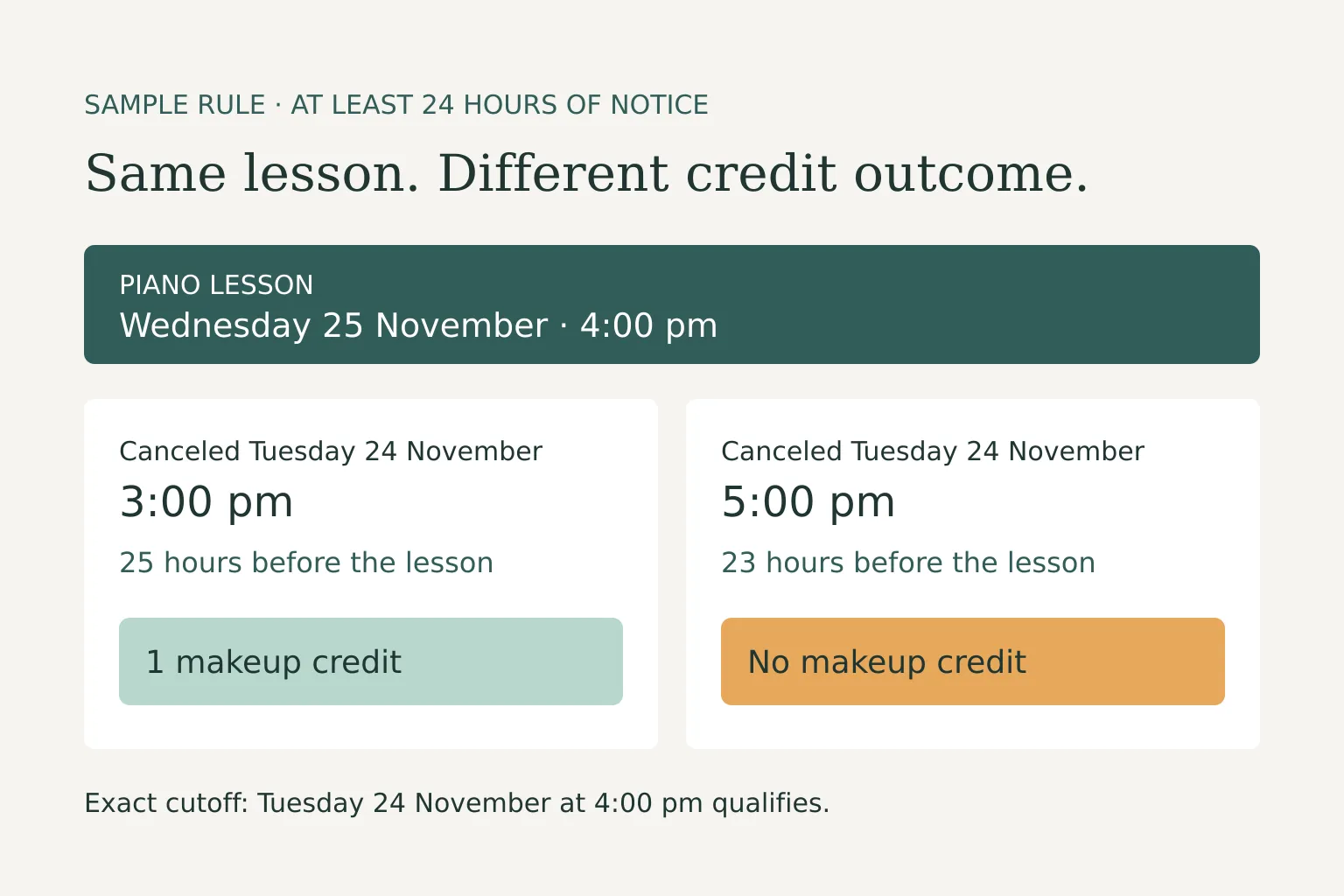
Say a piano lesson is scheduled for Wednesday, 25 November 2026, at 4:00 pm, and the teacher's agreed policy uses the time the cancellation message arrives. All times below are in the studio's local time zone, with no clock change during the example.
- Tuesday, 24 November, 3:00 pm: 25 hours of notice. One makeup credit under this sample rule.
- Tuesday, 24 November, 4:00 pm: Exactly 24 hours of notice. One makeup credit under this sample rule.
- Tuesday, 24 November, 5:00 pm: 23 hours of notice. No makeup credit under this sample rule.
Record the source lesson, cancellation timestamp, rule applied and decision together. A message such as “We can't come tomorrow” needs a timestamp; the word “tomorrow” doesn't establish whether the notice requirement was met.
Earning a credit and booking it are separate decisions
A makeup credit is permission under the teacher's policy to take a replacement lesson. An available credit does not mean a particular time is reserved. Keep the credit decision separate from the booking confirmation.
For the qualifying cancellation above, the record might show:
- Source lesson: 25 November, 4:00 pm, 30-minute piano lesson.
- Credit decision: One credit awarded; 25 hours of notice met the 24-hour rule.
- Deadline: None, under this example's chosen policy.
- Booking status: Not booked.
If the family requests 2 December at 4:00 pm, leave the status as “requested” until you confirm that slot. After confirmation, link the credit to that replacement lesson so it isn't used again.
What if there is no makeup time available?
No suitable makeup time does not, by itself, cancel an awarded credit. Apply the no-availability rule you agreed with the family, and record the next step. Don't label a credit expired just because it has been sitting unused.
Before setting an expiry window, decide whether the family must book before the deadline or take the lesson before it. Those rules differ: a booking confirmed on 20 December for a lesson on 8 January may satisfy the first and fail the second. Write the exact date, time and time zone on the credit record.
Also test a teacher-canceled makeup near the deadline. If the original deadline remains, what replacement can you actually offer? Resolve that in the policy before it happens to a family.
Send the policy with a clear start date
Give families the revised policy before the first lesson it will cover. Keep previously awarded credits tied to the terms under which you awarded them, rather than silently applying a new deadline.
You can send:
From [date], we'll use the attached cancellation and makeup policy for new lesson cancellations. It explains how to cancel, when a makeup credit is available, and how to arrange a replacement lesson. Your existing credits are [state their actual status and applicable terms]. Please reply if you'd like me to clarify a rule before it starts.
Keep a dated copy of the policy and any agreed exception. That gives you a specific rule to refer to when a family asks about a lesson later.
Test the rule before you send it
Meloop's free cancellation rule tester lets music teachers try fictional notice and credit-deadline scenarios and copy the resulting explanation, without an account. Its notice calculation uses when the teacher records the cancellation, so check that against the channel rule you've chosen. For a manual record, use the printable makeup-credit tracking sheet to keep the source lesson, decision and booking status together.